How to Receive Dollars in Nigeria With USDT or USDC
Get paid to your @handle, pick the right network, cash out to naira, and see when a USD account fits better.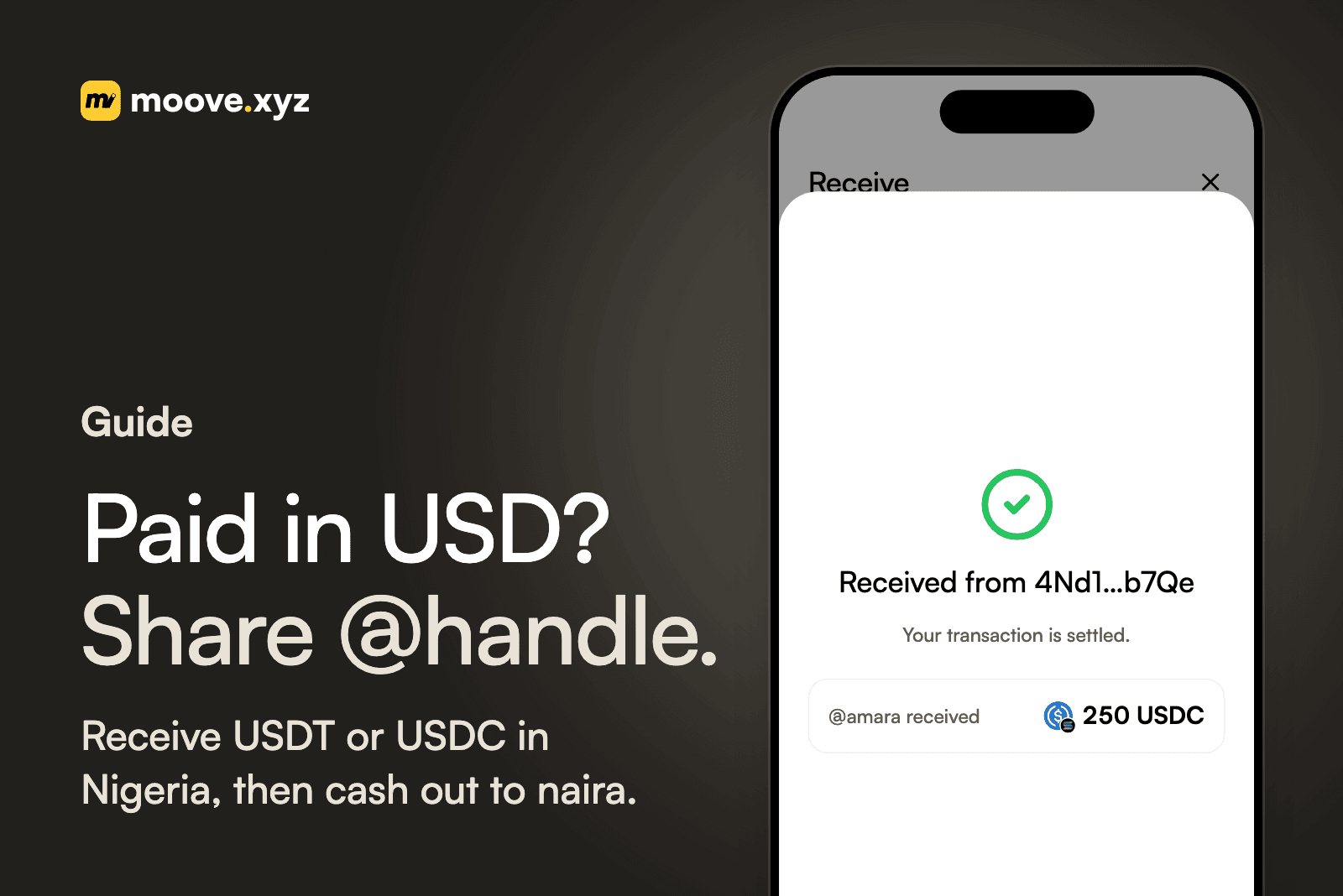
How to Receive Dollars in Nigeria With USDT
To receive dollars in Nigeria with USDT, give your client your moove.xyz @handle or your wallet address and ask them to send USDT or USDC, the two stablecoins that track the US dollar. The money lands in a wallet only you control. You can keep it as dollars, or cash out to naira in your own bank account once you have verified your identity.
That is the short answer. This guide covers the rest: when stablecoins are the right way to get paid in dollars, when a USD account is the better tool, how to pick the right network, and how to turn what you receive into naira without guesswork.
Stablecoin or USD Account: Which Way of Getting Paid Fits You?
Before you change how you get paid, be honest about who is paying you and how. The right tool depends on what your payer can send.
A USD account wins when your payer can only send a bank transfer. Services such as Grey, Raenest and Cleva give you US account details, so a client or platform can pay you by ACH or wire as if you were a US business. moove.xyz cannot receive an ACH payment or a wire. If your income comes from a platform or an employer that only pays to a bank account, a USD account is the right fit, and you should use one.
Stablecoins win when your payer can send USDT or USDC. More clients, agencies and remote teams now pay in stablecoins, especially across borders. When they can, receiving USDT or USDC has real advantages:
- No account details to share. You give a short @handle, not a routing number and an account number.
- No intermediary bank. The payment goes from their wallet to yours on a public blockchain, and you can see it arrive.
- Dollars you control. USDT and USDC hold their value at about one dollar, and they sit in a self-custody wallet that only you can move.
- The payer can use what they hold. A payment to your handle converts into the token you chose, so a client holding ETH or USDC on another chain can still pay you.
Many freelancers use both: a USD account for platform payouts, and a stablecoin wallet for clients who pay directly. If you want the wider picture, our guide to getting paid in stablecoins as a freelancer walks through invoicing and pricing your work.
What You Need to Receive USD Payments in Nigeria
Getting set up takes a phone and a few details:
- The Moove app, on iPhone or Android. Creating your wallet also gives you your @handle.
- Your @handle. This is your payment name, such as
@adaeze. It points to your default wallet, so nobody has to copy a long address. Read more about the Moove Handle. - A settlement token. This is the token and network every payment to your handle converts into. You set it on the web, under Settings, then Edit Moove Profile, then Edit wallet & settlement.
- A verified identity, if you plan to cash out. You can receive and hold stablecoins without it, but selling for naira through Moove Ramp needs identity verification, and the payout account must be in your own name.
How to Get Paid in Dollars, Step by Step
1. Set your settlement token to USDT or USDC on Solana
If you want to turn some of your dollars into naira later, choose USDT or USDC on Solana as your settlement token. moove.xyz pays out naira from those two stablecoins on Solana, so settling there means you can cash out without moving funds between networks first. If you would rather hold dollars long term, USDC is a common choice.
2. Share your @handle with your client
Open the Receive tab in the app. You can copy your @handle, copy your Moove Profile link, or share a QR code. Put your handle on your invoice next to the amount and the stablecoin you expect, for example "Pay 500 USDT to @adaeze on moove.xyz".
If your client also uses moove.xyz, they send to your handle and the routing is handled for them. If they pay from another wallet or an exchange, they can open your Moove Profile link and pay from any wallet they connect.
3. Or share your wallet address and the exact network
Some payers, such as exchanges, can only send to an address. In that case, share the address for the network you agreed, and write the network next to it: "USDT on Solana" is not the same as "USDT on Tron". You can see your receive address for each network on the receive USDT page.
4. Confirm the payment arrived
When the payment confirms on the blockchain, it shows up in your wallet and your activity. Stablecoin payments are final once confirmed. There is no chargeback, so a client cannot pull the money back after the fact.
Pick the Right Network Before Anyone Sends
The network is where most stablecoin payments go wrong. USDT exists on several blockchains, including Tron, Ethereum, BNB Chain and Solana, and each one is a separate road. If a client sends USDT on Tron to an address you only use on Solana, the funds do not arrive where you expect.
A few rules keep you safe:
- Agree the network in writing, on the invoice, before the first payment.
- Prefer your @handle when the payer can use it, because it resolves to your wallet for them.
- Ask for a small test payment the first time you work with a new client or a new exchange.
- Check what the exchange defaults to. Many exchanges pick Tron or BNB Chain unless you change it.
If a payment ever does land on the wrong network, read what to do when crypto is sent to the wrong network before you try anything else. To compare the networks themselves, see which blockchain to use for stablecoins.
Cashing Out Your Dollars to Naira
Receiving dollars is half the job. When rent or school fees are due, you need naira in your account. With moove.xyz you sell USDT or USDC through Moove Ramp in the app and receive naira in a bank or wallet account in your own name, such as OPay, PalmPay, Moniepoint or a bank.
The flow is short:
- Verify your identity in the app. Have your BVN or NIN ready.
- Link a naira account in your own legal name.
- Choose USDT or USDC on Solana, enter an amount and read the quote.
- Confirm, and follow the payout in your activity.
The quote shows the naira amount you will receive and the fees before you confirm. moove.xyz charges a flat 0.10% on a naira cash-out, plus the network fee for sending the crypto, and your bank may add its own charge. The live rate is on the USDT to naira page, which is the place to check it rather than any figure you read in a blog post.
You do not have to convert everything you earn. Many people keep part of their income in stablecoins and cash out only what they need each month. Our step-by-step guide to cashing out USDT and USDC to naira covers supported accounts, limits and the mistakes that delay a payout.
Is It Legal to Receive Dollars in USDT in Nigeria?
No Nigerian law bans individuals from holding or receiving stablecoins such as USDT or USDC, but the rules have changed several times. In December 2023 the Central Bank of Nigeria replaced its 2021 directive with guidelines that let banks open designated accounts for SEC-licensed virtual asset service providers. The Investments and Securities Act 2025 treats virtual assets as securities under SEC oversight. Tax on your income applies however you are paid.
This is general information, not legal or tax advice. Rules can change, so check the current position before you rely on it, and speak to a professional about your own situation. Our explainer on crypto rules in Nigeria sets out what the SEC and CBN have said and how income tax applies.
Common Mistakes When Getting Paid in USDT
- Not naming the network. An invoice that says "pay in USDT" without a network invites a payment you cannot find.
- Sharing an exchange deposit address for client work. Exchanges can freeze or question deposits from unknown senders. A wallet you control avoids that.
- Settling in a token you cannot cash out. If you plan to sell for naira, settle in USDT or USDC on Solana.
- Verifying at the last minute. Do your identity check before the day you need naira.
- Using someone else's bank account. Naira payouts only go to an account in your own name.
Get Paid in Dollars With moove.xyz
If your clients can pay in stablecoins, you can receive dollars in Nigeria without sharing bank details, hold them in a wallet only you control, and cash out to naira when you choose. Where a payer can only send a bank transfer, a USD account is still the right tool, and nothing stops you from using both.
Set up your Moove Wallet and share your @handle with your next client.
About moove.xyz
moove.xyz is an everyday money app for digital dollars. Hold USDT and USDC in a wallet that is yours, send to anyone by their @handle, swap across 30+ chains, and cash out to your local currency where Moove Ramp is available.
Your money. Your move.
Frequently asked questions
How do I receive dollars in Nigeria with USDT?
Can I receive USD payments in Nigeria without a domiciliary account?
How do I receive payment from Upwork in Nigeria?
Which network should my client use to send USDT?
How do I get paid in dollars in Nigeria and convert to naira?
Get the Moove App
Hold USDT and USDC in a wallet that is yours, and send to anyone by their @handle.