Friendly Fraud: What It Is And How To Fight It
Friendly fraud is a chargeback on a purchase the buyer really made. See why it happens, how to fight it with Visa CE 3.0 evidence, and how to cut the risk.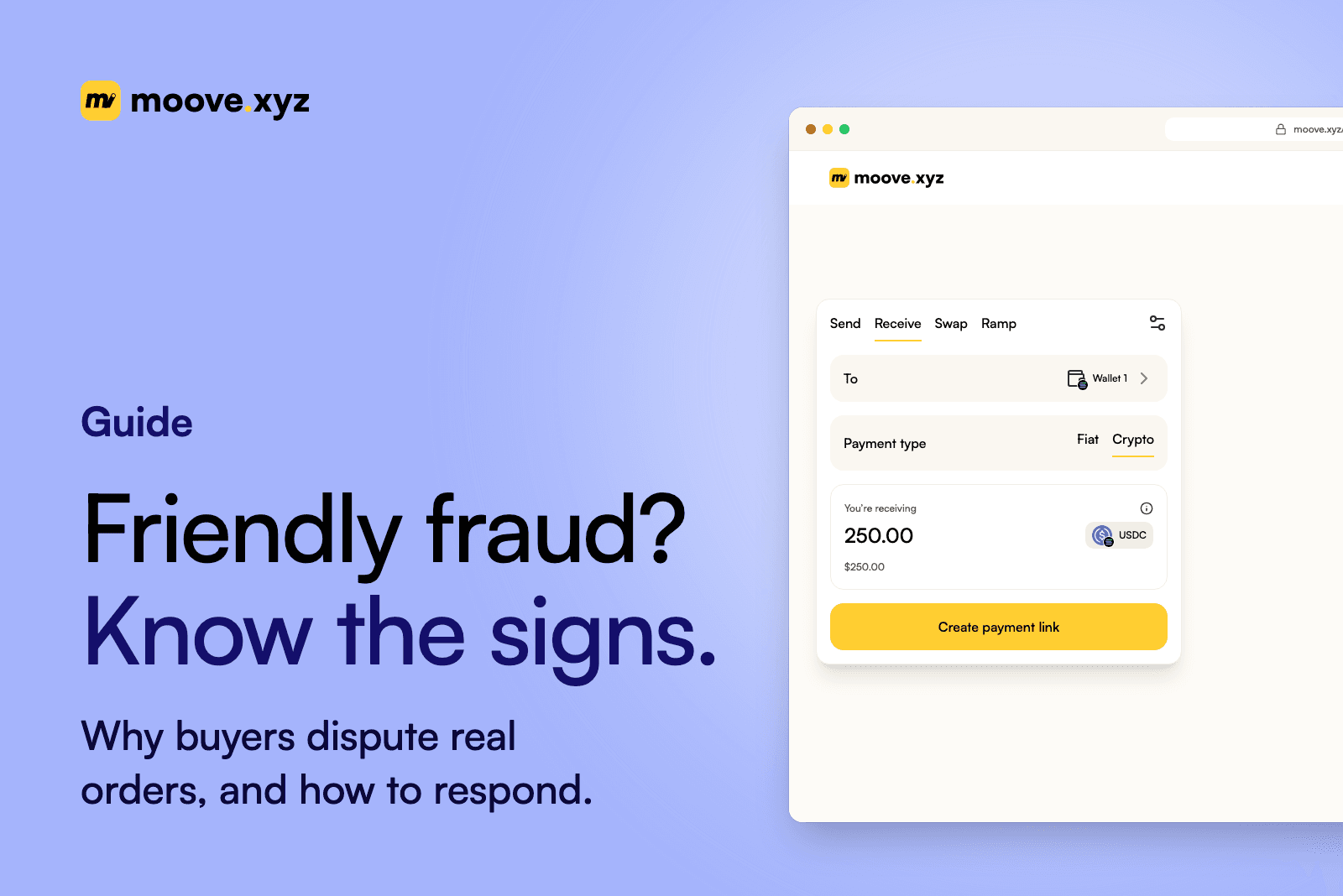
Friendly Fraud: What It Means For A Merchant
Friendly fraud is a chargeback on a purchase the customer really made. You shipped the order or delivered the service, then the buyer's bank reversed the payment because the buyer said it was unauthorised, never arrived or was not as described. This guide explains why friendly fraud happens, what to do in the first 48 hours, how to fight it with the evidence the card networks accept, and where a stablecoin payment link genuinely helps and where it does not.
This is general information, not legal, tax or financial advice. For anything specific to your account, your processor's own support team is the right first call.
What Is Friendly Fraud, And Why Does It Happen?
The card networks have their own names for it. Visa calls it first-party misuse: a cardholder reporting fraud on a transaction they authorised. Mastercard describes first-party, or friendly, fraud as genuine transactions that cardholders challenge, either by mistake or on purpose. Stripe uses "chargeback fraud" for the same thing. Published estimates of how much of all chargebacks it accounts for vary widely between vendors, so treat any single figure with caution.
The causes of friendly fraud fall into two groups.
Accidental Friendly Fraud
- An unrecognised charge. The name on the card statement does not match the shop the buyer remembers, so they assume it is fraud.
- A purchase by someone else in the household. A partner or child used the saved card, and the cardholder did not know.
- A forgotten subscription or free trial. The renewal arrives, the buyer does not remember signing up, and disputing feels easier than contacting you.
- A slow or confusing refund. A buyer who asked for a refund and heard nothing goes to the bank instead.
Deliberate Friendly Fraud
- "Item not received" after delivery. The tracking says delivered, but the claim says otherwise.
- "Unauthorised" after using the product. The buyer received and used the goods, then claims they never made the purchase.
- Buyer's remorse. The buyer wants their money back without returning anything.
Card disputes exist to protect buyers from genuine fraud and from merchants who do not deliver. Processors and issuers apply those rules in good faith, and they cannot always tell an honest dispute from a dishonest one at the moment it is filed. That is why your evidence matters when you fight friendly fraud.
What To Do In The First 48 Hours After A Friendly Fraud Chargeback
- Read the reason code. A fraud reason, an "item not received" reason and a cancelled-subscription reason each need different evidence. Visa's own FAQ notes that subscription disputes are often coded as cancelled recurring rather than fraud, which changes what evidence applies.
- Check the deadline. Stripe's documentation says the response window is usually 7 to 21 days, and you get one submission that you cannot edit afterwards.
- Pull the customer's history. Earlier orders, account logins, device and IP data, delivery confirmations and any messages from the buyer are your strongest material.
- Contact the customer, politely. Many accidental friendly fraud cases end once the buyer recognises the order. Never pressure or threaten them; keep the message factual.
- Build a short, readable evidence pack. Stripe says banks do not open links, audio or video, and caps the total file size, so use clear documents and screenshots.
- Decide whether to accept. If the evidence is thin, accepting a small dispute can cost less than countering it.
How To Fight Friendly Fraud With Evidence
Visa Compelling Evidence 3.0
For Visa fraud disputes (reason code 10.4), Visa's Compelling Evidence 3.0 rules are the main tool against friendly fraud: they let a merchant show that the cardholder took part in the transaction. According to Visa's merchant FAQ, you need two earlier undisputed transactions on the same card, dated 120 to 365 days before the dispute. At least two of four data elements must match the disputed transaction: the customer's account or login ID, the delivery address, the device ID or fingerprint, and the IP address. One of the two matches must be the device ID, fingerprint or IP address. When the evidence qualifies, liability moves to the card issuer. Stripe says it checks Visa 10.4 disputes for CE 3.0 eligibility automatically, but it can only use the data you collected.
Mastercard First-Party Trust
Mastercard announced its First-Party Trust programme in October 2023, built with merchant industry groups. Merchants share enhanced transaction data, either at authorisation or during a dispute, and Mastercard's compelling-evidence rules give chargeback protection when the data-sharing requirements are met. Ask your processor whether it supports the programme.
Pre-Dispute Alerts
Mastercard's Ethoca Alerts tell a merchant in real time that a customer has raised a dispute or confirmed fraud with their bank, so you can refund before it becomes a chargeback. Mastercard advises sending an outcome within 24 hours. A refund at that stage costs you the sale but avoids the dispute fee.
How To Lower The Risk Of Friendly Fraud
- Make the charge recognisable. A billing descriptor customers can match to your name, and a receipt that names it, removes a whole class of "I don't know this charge" disputes.
- Collect the data CE 3.0 needs. Record logins, device IDs, IP addresses and delivery addresses for every order, so the evidence exists before a dispute does.
- Confirm everything. Order confirmations, shipping notices, tracking and proof of delivery all help.
- Make cancelling and refunds easy. Renewal reminders, an obvious cancel button and fast refunds keep buyers from going to their bank first.
- Keep your terms visible. Show your refund, cancellation and delivery policy before checkout, and keep a copy of what the buyer agreed to.
- Watch repeat disputers. Deliberate friendly fraud often repeats, so a customer who has disputed before is worth a second look before you ship again.
Your Options Compared
| Fight disputes on cards | Add pre-dispute alerts | A high-risk merchant account | A stablecoin payment link (Moove) | |
|---|---|---|---|---|
| Cost of a dispute | Stripe US lists $15 per dispute received and $15 more to counter it, returned if you win; PayPal US lists a $20 chargeback fee¹ | Not published, varies by provider | Not published, varies by provider | No card-network dispute process against the merchant² |
| How you respond | One evidence submission, usually within 7 to 21 days; a decision can take up to three months³ | Refund before the dispute becomes a chargeback, ideally within 24 hours⁴ | Standard card-network dispute process applies | Not applicable. The payment is final; refunds are sent by you² |
| Evidence that can win | Visa CE 3.0 for fraud disputes, Mastercard First-Party Trust where supported⁵ | Not applicable, the dispute is avoided rather than won | Same card-network rules | Not applicable |
| Onboarding | Business verification and a risk review | Through your processor or an alert provider | Application and underwriting | No application or approval process to create a link⁶ |
| Buyer protection | Cardholder can dispute | Cardholder can dispute | Cardholder can dispute | None. The buyer gives up card dispute rights² |
A cell marked "Not published" is one no source below states publicly. The numbered notes refer to the sources section at the end of this guide.
How Moove Works For Friendly Fraud
A Moove Payment Link lets you take a payment in stablecoins without a merchant account. Moove's Terms of Service say it operates no application, registration or approval process for merchants. The buyer opens the link, connects any wallet and pays in whatever token they hold, and the payment settles straight to a non-custodial wallet that only you control. Moove never holds a balance, so there is nothing for it to freeze.
Because an on-chain payment is a push payment and is final once settled, there is no card-network chargeback process against you, which removes the chargeback mechanism that friendly fraud depends on. That has a flip side you should say out loud to buyers. They give up card dispute rights, and any refund is something you send by a separate transfer. Moove's Terms of Service say it provides no chargeback, buyer-protection, escrow or dispute-resolution service, and they prohibit ignoring refund requests or delivery questions after being paid. A stablecoin link removes the chargeback. It does not remove the need to treat buyers fairly.
On pricing, Moove's pricing page says a same-chain, same-token payment carries no Moove fee, anything cross-chain or cross-token carries a 0.02% protocol fee, and on a payment link the payer covers it. Network gas is separate, and there is no subscription or monthly minimum.
The Send and Receive guide explains how value moves between wallets, and freelancers will find the practical side in how to get paid in stablecoins. If you want local currency, Moove Ramp cashes out to a bank account in Nigeria today — for example USDC to naira — through a licensed partner that runs its own identity checks.
Two limits matter here. Moove is non-custodial, but a stablecoin issuer can still freeze a specific address. And Moove's Terms of Service prohibit some businesses outright, so permissionless does not mean anything goes.
Where A Card Processor Is Still The Better Fit
A stablecoin link is a complement for some of your sales, not a replacement for a card checkout.
- Your customers do not hold crypto. A payment link accepts crypto from a connected wallet. It is not a way for a buyer to pay your invoice by card.
- Your customers expect dispute protection. Many buyers use cards precisely because they can dispute a payment, and some will not give that up.
- You are a company rather than an individual. Moove's Terms of Service say the platform is for natural persons acting on their own account, and it prohibits accepting payments on behalf of a third party, which rules out most agency and marketplace models.
- You need recurring billing or a long-lived checkout. Links made in the Moove widget are single-use; a usage cap or an expiry date needs the payment-link API.
- You need cash in a bank account outside Nigeria. Moove Ramp's cash-out is live in Nigeria only.
Sources And How This Was Checked
- Stripe's dispute fees by country, including $15 received and $15 countered in the US: support.stripe.com/questions/june-2025-pricing-updates-for-disputes. PayPal's US card chargeback fee: paypal.com/us/business/paypal-business-fees. Both checked November 7, 2026.
- Payments settle on public blockchains and are irreversible; no chargeback, buyer-protection, escrow or dispute-resolution service; refunds by separate transfer; no ignoring refund requests: Moove Terms of Service, clauses 7.2 and 9.5, last updated September 12, 2026 and checked November 7, 2026.
- The 7 to 21 day response window, one submission, the no-links rule, file limits, the up to three month decision and automatic CE 3.0 checks: docs.stripe.com/disputes/responding, checked November 7, 2026.
- Ethoca Alerts and the 24-hour outcome guidance: Mastercard Ethoca Alerts for merchants, checked November 7, 2026.
- Visa's first-party misuse definition and the Compelling Evidence 3.0 criteria: Visa, Evolution of Compelling Evidence merchant FAQs. Mastercard's description of friendly fraud and First-Party Trust: Mastercard newsroom, October 2023. Stripe's "chargeback fraud" term: stripe.com/resources/more/what-is-friendly-fraud. All checked November 7, 2026.
- No application, registration or approval process for merchants, prohibited businesses, natural persons only and no payments on behalf of a third party: Moove Terms of Service, clauses 3.2, 7.2 and 7.3, checked November 7, 2026.
- Moove is non-custodial and holds no balance: Non-custodial Wallets and FAQ. Moove's fees: How Product & Prices Work. Single-use widget links and API-only caps and expiry: Moove Receive. Ramp corridors: Moove Ramp. All checked November 7, 2026.
Figures were checked on November 7, 2026 and may have changed; check the provider's own pages before deciding. Stripe, PayPal, Visa, Mastercard and Ethoca are trademarks of their respective owners. moove.xyz is not affiliated with or endorsed by Stripe, PayPal, Visa or Mastercard.
Take Stablecoin Payments Without A Chargeback Process
If some of your buyers already hold stablecoins, a payment link gives them a route that carries no chargeback exposure for you, while your card processor keeps serving everyone else.
👉 Ready to try it?
Create a free Moove Payment Link at moove.xyz and get paid directly to a wallet only you control.
About moove.xyz
moove.xyz is a global Web3 fintech platform built for the permissionless and effortless movement of value. We empower businesses and consumers anywhere to send, receive, stake, and swap any cryptocurrencies across any blockchains, all in one single platform.
We are one of the first Web3 fintech companies globally to innovate and build a full-stack crypto payments and decentralised finance infrastructure, enabling an integrated and comprehensive coverage across multi-chain wallet access, personalised wallet handles, cross-chain token swaps, embedded cross-chain transactions and a decentralised social financial network. Our key products include Moove Profile, Moove Send, Moove Receive, Moove Stake, Moove Swap, Moove Rewards, Moove Discover and more.
Our mission is simple — to create and distribute permissionless and effortless financial technology for the next 1 billion Web3 users. We fundamentally believe that the future of the movement of money and value shall be costless, borderless, permissionless, effortless, and built for everyone — and we're building the ultimate Web3 fintech platform to make that future real.
Your money. Your move.